


Pearl Lorentzen
Lakeside Leader
The Town of Slave Lake, M.D. of Lesser Slave River (124), and the M.D. of Opportunity (17) all grew between 2016 and 2021.
According to the 2021 Census, Slave Lake remained the largest of the three with a population of 6,836 (from 6,651). Next was M.D. 17 with 3,382 (from 3,253). Followed by M.D. 124 with 2,861 (from 2,803).
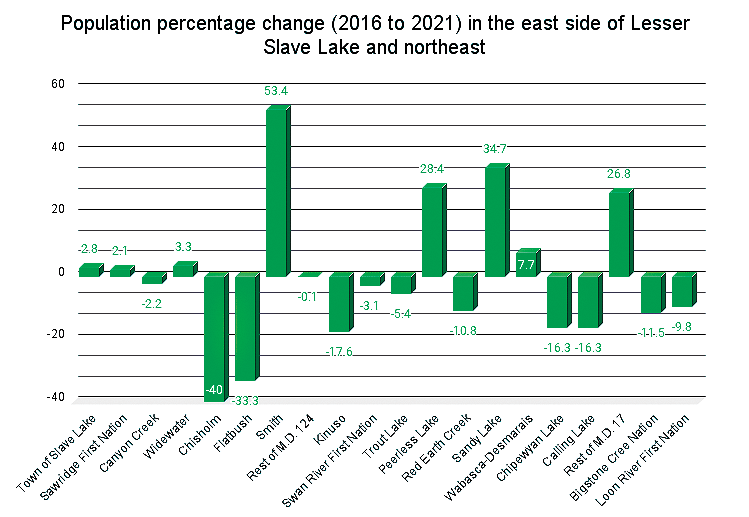
The biggest change was in M.D. 17, which had a population percentage change of four. Slave Lake grew by 2.8 per cent, and M.D. 124 by 2.1 per cent.
However, the growth in the two M.D.s was not evenly distributed.
In M.D. 124, Widewater and Smith grew, but Canyon Creek, Chisholm, Flatbush, and the non-hamlet population shrank. The biggest changes in M.D. 124 were in Chisholm (minus 40 per cent) and Smith (53.4 per cent).
In the census, Peerless Trout First Nation population is listed as zero. However, both the hamlets of Peerless Lake and Trout Lake are listed and presumably included in the M.D. 17 numbers.
There’s a transition of responsibility happening from the M.D. to the Peerless Trout FN, which is likely the reason for the difference.
In M.D. 17, Peerless Lake, Red Earth Creek, and the non-hamlet portion grew. The rest of the hamlets decreased. (See graph on Page 8 for hamlet populations and other details).
In M.D. 124, the majority of people (1,866 in 2021) didn’t live in a hamlet. However, the exact opposite was true in M.D. 17 with only a tiny portion (104 in 2021) not in one of the communities.
Kinuso decreased by 17.6 per cent – to 150 from 182.
First Nation population numbers only include the number of people living on reserve, not the full list of band members.
Of the nearby First Nations, Sawridge by Slave Lake was the only one which grew. It grew to 51 from 30, a change of 70 per cent.
About half way between Slave Lake and High Prairie, Swan River First Nation on reserve population decreased to 400 from 413 (-3.1 per cent).
Bigstone has land around Wabasca Lake and Calling Lake. Bigstone Cree Nation decreased to 1,951 from 2,205 (-11.5 per cent).
In 2021, Loon River First Nation population was 487, which was down from 540 in 2016. This was a decrease of 9.8 per cent.
Loon River FN is 164 km north of Slave Lake on Hwy. 88 near Red Earth Creek.
Homes
The Canada 2021 Census information released on Feb. 9, 2022, also included information about ‘private dwellings’ and ‘private dwelling occupied by usual residents.’
Private dwellings refer to homes and private dwellings occupied by usual residents is a home where people are living.
In all the communities, some of the homes were not occupied.


In all communities, at least some of the homes were empty.