


Pearl Lorentzen
Lakebside Leader
“It was a pretty extraordinary month,” said Jule Asterisk, at the Slave Lake Homeless Coalition meeting on March 4.
Asterisk is the coordinator for the coalition which runs the Temporary Friendship Mat Program in Slave Lake. It provides a warm place to stay out of the cold during the winter months for people experiencing homelessness.
From the end of January to February 25, the Mat Program had a COVID-19 outbreak.
During the day, there were up to 17 people in a space registered for 14, explained Asterisk. Numbers went down at night, but a few times it maxed out at 14.
During that time, there were 12 incidents. One individual with extremely high needs caused a few of these. Another issue was that the security staff hadn’t had the Homeless Institute Training yet.
There were also three temporary bans, added Asterisk. “One is now back and working on getting their three warnings removed.”
In response to the issues, there have been a few changes, said Asterisk. These include a buzzer on the women’s door, so they could know if someone had come in or out.
Also, some security guards were let go. Another one is on a health break. To fill the gaps, the shelter hired a professional security firm.
Moving forward, Asterisk recommends always advertising for security staff. Also, before they start, all staff take the Homeless Institute Training. It takes three hours.
From October 30, 2021 to February 28, 2022, the Mat Program helped 89 individuals. Of these, only a couple have been using the program since the very beginning, said Asterisk.
In the fall, the coalition predicted 1,000 stays by the end of March, she added. It has already passed this number with 1,099 stays. This averaged people 11 per night. Of these, 69 per cent are men and 31 per cent women.
The coalition has applied to extend the Mat Program to the end of April.
As of March 4, it had received permission from the provincial government, which funds the day program and isolation unit. It was waiting to hear back from the Rural Development Network (RDN), which funds overnight security and some other expenses.
During a portion of the COVID outbreak, there wasn’t an isolation facility in Slave Lake. A new one has been found.
It was good timing, as someone needed treatment for a contagious parasite, said Asterisk. However, it hasn’t been needed for COVID yet.
During the day, the Mat Program has three support workers who run a program called Sweetgrass Supports.
There’s been “a lot of hand-holding, a lot of support, and lots of teaching, modeling,” said Marlina Auger, one of the support workers.
Highlights include one woman going to the eye doctor for the first time in five years and getting new glasses. Two people were signed up for a Suboxone program to help with opioid addiction.
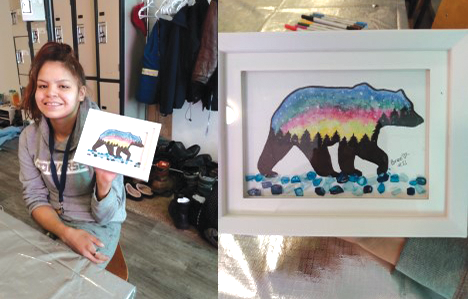
Sophia Cyre does Cree cultural teachings, traditional art, and helps out in other ways.
“The art is very important and engaging,” she said. “The art gives us a platform to share. (It also provides an opportunity) to let our participants know they are capable of making beautiful things.”
Cyre also brought her puppies in for some puppy therapy.
At the meeting, Susan Giesbrecht asked how many of the younger people at the Mat Program had aged out of foster care.
Around 30 to 40 per cent of the young women answered Cyre. Slave Lake has a need for transitional housing and programs which teach basic life skills.
All staff and board energy is focused on daily operations, said Asterisk. This is because there’s been “that much day-to-day crisis.”
After the end of April, the focus will switch to finding a permanent home for the program.
The next public Homeless Coalition meeting is April 1 starting at 1:30 p.m.

Courtesy of the Slave Lake Homeless Coalition.