


Joe McWilliams
Lakeside Leader
Last week’s moisture was very welcome – at least from the point of view of wildfire hazard reduction. Warm, dry, windy weather in spring can result in bad things, as people in the Slave Lake area know only too well.
But so far, so good in the forest protection game. There have been a few fires, but nothing beyond the resources of the authorities to handle.
One fire was near the Summerwood neighbourhood north of Slave Lake. Another was 14 kilometres southeast of Kinuso.
The Summerwood fire was a grass fire on April 25 that reached about two hectares in size and did not threaten the community.
Four fires showed up on the April 23 weekend. The most notable was the one southeast of Kinuso, which started on the 24th. By the next morning, it was listed as 136 hectares in size and was also not threatening any community.
Judging by the aerial photo, it was mostly a grass fire.
At the time of the report, 18 firefighters, two helicopters and various other pieces of heavy equipment had been dispatched to work the fire.
Also on April 25, which was a warm day with strong winds, there was a fire in the Red Earth Creek area. Wildland firefighters and the local fire department teamed up to knock it down fairly quickly.
So far this year (as of the date April 27) there had been 13 fires in the Slave Lake Forest area, with a total area burned of 165 ha. In the same period, provincially, there had been 128 wildfires, burning 335 hectares. So the Lesser Slave area has had about 10 per cent of the fires this year, but 49 per cent of the area burned.
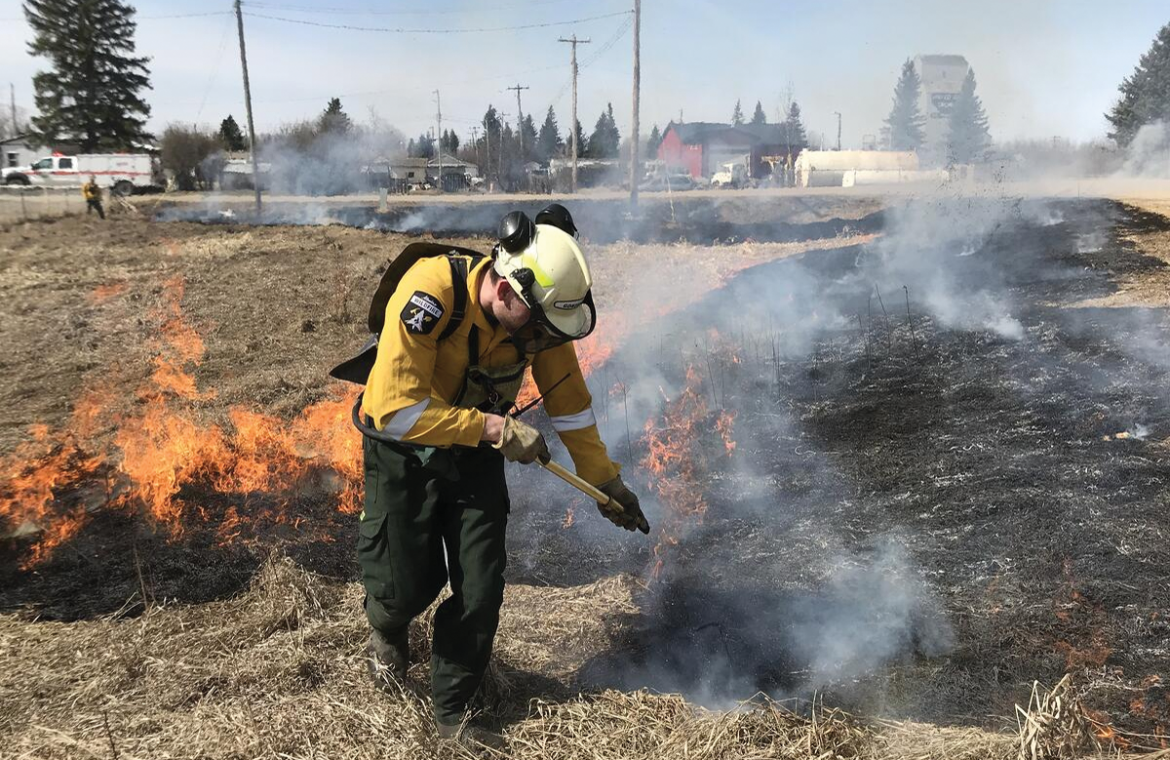
As noted above, the period between the snow disappearing and ‘green-up’ is a risky one. That’s why the wildland firefighters and municipal fire departments are teaming up to do hazard-reduction burning. Wildfire Information Officer Leah Lovequist says across the SL Forest area, 500-600 hectares of grass are burned in a typical year.
Seasonal staff are “arriving in waves,” Lovequist says. Just over half were in place as of April 25. Expect the government air tankers to show up at the Slave Lake airport by mid-May, pretty much as soon as there are “skimmable water bodies.”
The other type of water bombers (the ones that load retardant at the airport) are already on contract for the season, but won’t necessarily be deployed to Slave Lake.
As for the fire lookout towers, Lovequist said, as of April 25, 13 were staffed, with four more ready to begin within the next couple of days.
